
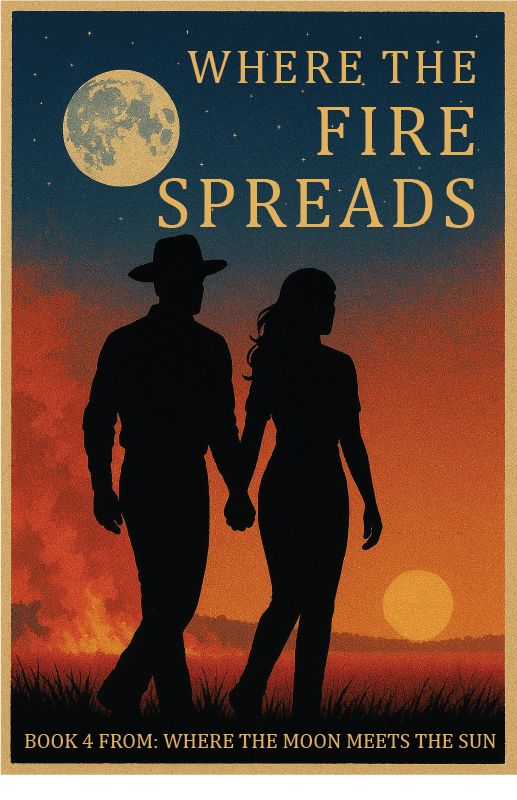
Chapter 1: Mist and Silence
He stood there for a long while, staring out across the pasture. Mist clung low over the creekbed where Zoey had once said, “This is where we’ll build our life.” And they had.
The house behind him was simple. Rammed earth and timber, solid and clean. Built by callused hands, faith, and stubbornness. A home that breathed in rhythm with the land.
Jack took a slow sip, then another. Not out of rush. Not out of habit. Just because it was warm, and he liked the quiet. He had learned the shape of silence in that cell, how it moved, how it shifted depending on whether you feared it or welcomed it.
He welcomed it now.
A scrap of paper sat on the porch rail, four short poetic lines he’d jotted down while the coffee brewed. He didn’t show them to anyone, not even Zoey. Not yet.
He glanced toward the pasture, then back to the door.
They’d started talking about a baby again. Carefully. Since he’d come home, it hung in the space between toothbrushes and early dinners. The night before he was taken, they’d discussed it. And now… Jack wasn’t letting outside forces define the world he shared with Zoey. He was ready, not because the timing was perfect, but because he refused to let anyone rob him of peace, or presence, or the future they were building together.
The door cracked.
Zoey stepped out, wrapped in one of his old flannel shirts, her hair tied in a lazy knot. She didn’t say a word. She just looked at him like she already knew what was in his mind. Then she stepped up and leaned into him, her bare feet finding the same cool floorboards he stood on.
Her hand found his, the way it always did when the world hadn’t yet demanded anything of them.
They watched the light come.
“Sleep okay?” she murmured.
“Better than I did last month,” he said with a soft smile.
Zoey chuckled, rested her head against his shoulder. “I still don’t know how you came back calmer than you left.”
Jack shrugged. “Sometimes a storm scrubs things clean.”
The cattle lowed in the distance. A wind finally moved the trees.
They stood like that a while longer. Then, the faint chirp of a phone buzzed from inside, not hers, not his regular one. The signal phone.
Zoey didn’t move. Neither did Jack.
He looked at the rising sun, gold and new, then down at her hand in his.
There was no rush in him. No tension.
He leaned in, kissed her forehead, and said, “I’ll get it.”
Chapter 2: A Different Kind of Freedom
Jack walked up the hill past the barn, a mug of coffee in one hand, the sun still low behind him. The grass was slick with morning dew, and the wind carried the smell of horses and mesquite. Buck sat on an overturned feed bucket by the fence, smoking a half-cigar that had been relit more times than anyone could count.
“You’re up early,” Buck said without looking.
“Signal phone rang.” Jack took a seat next to him, stretching his legs out across the gravel. “Solomon. Militia leader’s dead. No one’s talkin’, but it smells bad.”
“Damn,” Buck muttered. “You think he’s in danger?”
Jack nodded. “He said things feel unstable. Asked if he might come here for a while.”
“Well,” Buck said, flicking ash into the dirt. “We got room. And I wouldn’t mind seein’ him again.”
They sat for a moment in the quiet. Jack sipped his coffee.
“You seem… different,” Buck finally said. “Calmer than you got any right to be, after everything. Zoey said the same thing. What changed?”
Jack looked out at the pasture, where the cattle moved like slow clouds. “Back in Africa, I told Zoey something. That love isn’t about needing. It’s about choosing.”
Buck gave a small grunt of acknowledgment.
Jack went on. “While I was locked in that cell, I realized it’s not just about love. It’s life too. You don’t need to do anything. Not really. But you choose to do it. You take care of the people you love. Not because you’re afraid of failing them, but because you want to take care of them.”
Buck gave a slow nod, letting him finish.
“It’s a mindset shift,” Jack said. “I could have five things on my list today. But I could also just sit in the grass, feel the wind, taste the air. And I wouldn’t be behind. Because when I choose to start the work, it’s coming from peace, on my time I contol. Not pressure… I ain’t gone hippie Buck, but this thinking has really helped.”
Buck tapped the ashes from his cigar again. “A man with peace in his bones is rarer than rain in July.”
Jack smiled. “Did you just make that up?”
“Nope. Heard it once from a cowboy preacher in Amarillo. He also said ‘don’t trust a man who don’t like dogs or whiskey.’ Wise son of a bitch.”
Jack chuckled. “Sounds like he and my dad would’ve gotten along.”
Buck turned to him, eyes shaded by the brim of his hat. “All this choosing and peace and freedom, just don’t forget life still throws a punch now and then.”
“I know,” Jack said. “But I’m learning to roll with the punches on my terms, not react out of urgency.”
“Good,” Buck said, then leaned back, cigar dangling from his lips. “Because I have a feelin’ that phone call wasn’t the last storm cloud floatin’ our way.”
Jack stared at the horizon. “No,” he said quietly. “It wasn’t.”
But this time, he didn’t feel small against it.
Chapter 3: Laney’s Web
Laney McKenna had always looked comfortable in a room full of polished liars. Washington, D.C. was full of them. But the difference between her and the rest was that Laney didn’t lie to herself.
She sat across from Nash in a private booth at a back-alley café near the Capitol, steam curling from her untouched espresso. Her laptop was open, cables snaking into a discreet hard drive enclosure. Nash hunched beside her, scrolling through lines of decrypted metadata.
“These NGO files are dirtier than we thought,” Nash muttered. “Shell orgs, offshore accounts, back-channel donations to congressional races, half of these names have no idea they’re laundering influence.”
“And the other half know exactly what they’re doing,” Laney said. “Same ones who built that bogus case against Jack last month. It’s like a leash they can yank whenever they want.”
Nash paused. “You think they’re still gunning for him?”
Laney leaned back, eyes narrowing. “The militia leader who held Jack gets killed right after he lets him go? That doesn’t smell like coincidence. Someone’s sweeping up.”
Nash didn’t argue. He clicked through another encrypted folder, stopping at a spreadsheet flagged RED-P1 – GLOBAL MEDIA STRATEGY – MCCENNA LEVERAGE?
Laney frowned. “They spelled our name wrong.”
“Don’t think that was a typo.”
She snapped a photo of the screen with her burner phone and closed the laptop. “Let’s not stay here too long. If they’re still tracking old signals, they’ll sniff us out.”
Nash packed up the gear, but before they exited, Laney turned to him. “We need to put something on the table soon. Something public. They won’t risk exposure if this gets loud enough.”
Back in Texas, Buck was doing his own kind of recon.
He stood on the back porch, a rotary phone pressed to his ear. The line clicked twice, then a third time before a gravelly voice came through.
“Well I’ll be damned,” the voice said. “Didn’t expect to hear from you, Buck.”
“It’s that kind of year, Larry.”
Larry “Hawk” Hawkins had done a lot of things in Vietnam that never made it into any files. CIA contract work. Deep ops. The kind of jobs that didn’t come with medals, just ghosts.
“You still off-grid?” Buck asked.
“Close enough.”
“I need your eyes. Might have a loose-end problem overseas. Jack McKenna. You remember the name?”
There was a pause. Then Hawk said, “Yeah. Thought he was laying low.”
“So did I. Now the guy who held him hostage ends up dead, and folks who shouldn’t care are suddenly poking around.”
Hawk sighed. “Sounds like the Company’s doing spring cleaning.”
“My thought exactly. I need to know if Jack’s next on the list.”
“Where is he now?”
“Here. With the girl.”
“You want me to make him disappear?”
“No,” Buck said flatly. “I want to buy him time.”
Later that night, Jack stood by the barn fence, watching the stars blink into existence above the pasture. Buck joined him, hands deep in his jacket pockets.
“You heard from Solomon again?” Jack asked.
Buck shook his head. “Not since the first call. Still think he’s on his way.”
Jack sipped his beer. “Feels like it’s all starting up again.”
“It is,” Buck said simply.
Jack exhaled. “I’m not going back underground. I’ve already lived through that. Hid who I was. What I believed. I’m done disappearing.”
Buck didn’t respond immediately. Just looked out across the field where the wind swayed the tall grass.
“It ain’t about hiding,” Buck said finally. “It’s about playing chess instead of checkers.”
Jack turned to him, brow raised.
“They’re not playing fair,” Buck continued. “So stop waiting for a fair fight. Move first. Move smart. Like you said, choose what to do.”
Jack looked away, jaw tightening. “Feels like I just got this life. Built this house with my own damn hands. I want to stay.”
“I know,” Buck said. “But they’re counting on that. That’s how they get you.”
Silence stretched between them, heavy with everything unspoken.
Finally, Buck added, “Peace ain’t a place, Jack. It’s a mindset. You already found that. Now it’s time to make sure you get to keep it.”
Chapter 4: The Disappearance
They chose the farmers market for a reason, bustling, casual, public. Jack had only come for eggs and coffee beans, maybe a jar of wildflower honey if they had it. But the second black SUV didn’t belong.
Buck saw it first.
From across the street, he gave one sharp nod. Jack didn’t ask questions. He knew the play.
The man who bumped him near the kettle corn stand didn’t mean to start a fight, but Jack shoved back anyway. Hard. A bystander yelled. Someone pulled out a phone. Zoey’s voice cut through the crowd, sharp, panicked, perfect.
“Jack! What the hell are you doing?!”
The man staggered back, pretended to reach into his jacket. Jack knocked him sideways and stepped back fast. Another man lunged from the SUV, shouting something about resisting arrest.
But no badge came out. Just confusion. Noise. Flashes from phones.
And then Jack was gone, slipping through the alley behind the fruit stand, just like Hawk had mapped it.
The whole scene had lasted less than sixty seconds.
That night, the house felt empty.
Zoey sat on the edge of the bed, staring at the dent in Jack’s pillow. She had screamed at him in public, hit him in the chest, called him reckless. Played the furious partner for every camera and witness.
And now? Now she sat wrapped in one of his old T-shirts, her phone dark, her heart heavy.
The hardest part wasn’t the pretending. It was the silence.
She didn’t know where Hawk had taken him. That was the point. No trail. No link. Not even Buck knew the drop point. The fewer people who knew, the longer Jack stayed above water.
Still, she whispered into the room, “Be safe, cowboy.”
A thousand miles away, in a shuttered mountain lodge repurposed as a dead-drop safehouse, Jack sat with his boots off, watching Hawk burn his ID in a cast-iron stove.
“From here on,” Hawk said, “you’re nobody until I say otherwise.”
Jack leaned back, tired but composed. “That supposed to comfort me?”
“No,” Hawk said. “It’s supposed to keep you alive.”
Jack stared into the fire. “Just make sure it doesn’t last forever.”
Back in Texas, Buck worked the phone like a wartime general. He met Solomon and Reyes at a back table in an old VFW hall, papers spread out between beer mugs and a half-eaten plate of brisket.
“We’ve got two problems,” Buck said. “One, they’re cleaning house in Africa. Solomon made it out, but they’re not done. Two, someone wants Jack boxed in, maybe extradited, maybe erased. Either way, they want him isolated.”
Reyes nodded. “And what’s the good news?”
Buck lit a cigar. “They pissed off the wrong people.”
Solomon, who had just arrived from Kenya, leaned forward, folding his hands. “You think Laney can blow this open?”
“She’s working on it,” Buck said. “But we can’t wait. We need to make sure Jack’s not just hiding, he needs allies. Quiet ones. Ones who don’t blink when the alphabet boys come knocking.”
Reyes raised his glass. “Then let’s build him a damn army boys.”
Chapter 5: Sanctuary
The safehouse sat tucked into the pines, half-forgotten by the world, just a decaying lodge once used by game hunters and men who needed to disappear. Now it was Jack’s whole universe.
He kept the fire low, the windows curtained. A solar battery rig powered one light and the small stove. No internet. No clocks. Just time measured in sunrises and coffee cups.
Jack sat at the old dining table, a mechanical pencil in hand, a stack of graph paper spread before him. In the margins of a notebook once meant for hiding, he was designing something new.
A drill, lighter, simpler, tougher. One that didn’t need a team or a large truck to move it. A design that could survive not just Africa’s heat, but corruption, chaos, and red tape.
One man. One machine. One well at a time.
He drew late into the night, not out of urgency but focus. Pressure wasn’t the enemy anymore. Clarity had replaced adrenaline. He was learning that freedom wasn’t just movement. It was stillness with intent.
Two days later, she came.
Zoey slipped through the back trail at dusk, her hoodie pulled low, her backpack slung with supplies: fruit, tea, toothpaste, and something stronger hidden beneath the first aid kit.
When Jack opened the door, he didn’t speak. Just pulled her inside and wrapped her in his arms.
They sat on the floor beside the fire, knees touching, laughing softly over canned stew and stolen moments.
“Nice decorating,” she teased, eyeing the moss covered antlers above the fireplace.
Jack smirked. “I was going for Witness Protection rustic.”
Later, she explored the house, brushing dust from old maps and skimming pages of his sketches. When she found the new drill design, she turned to him with a look that asked without words: You’re still building?
“Always,” Jack said. “It keeps me sane.”
They made love quietly, without urgency. The kind of intimacy that doesn’t need to prove anything. The kind that says: You’re safe. You’re known.
Afterward, Jack lay beside her, the firelight flickering across his chest, her fingers tracing the scar on his ribs.
“I should feel trapped,” he said, voice low. “But I don’t. Even in here, I feel… clear.”
Zoey turned her head. “How?”
He thought for a long beat.
“Because I’m figuring out the difference between being hunted… and choosing. I can’t control what they do. But I can choose what I do. That’s where the power is. That’s where peace actually is.”
She smiled softly, kissed his shoulder.
“I just don’t want to lose you again,” she whispered.
“You won’t,” he said, pulling her close. “They may own the world. But we own our life.”
Chapter 6: Firewalls
Laney McKenna had dealt with Capitol Hill long enough to know when a door was being shut quietly… and when she was being locked out.
She and Nash had been making the rounds, closed-door meetings, favors called in, off-the-record inquiries. The deeper they dug into the encrypted Aid4All files, the more vague and polite the responses became. Eventually, the silence stopped being polite.
“We’re not getting stonewalled,” Laney muttered, pacing Nash’s dimly lit office above an old jazz club. “We’re getting firewalled.”
Nash didn’t disagree. He closed the file on his laptop and leaned back in his chair, eyes tired.
“There’s something deeper here. Not just corruption. This feels operational. Covered.”
Laney stopped pacing. “Then we need someone who’s tired of playing cover.”
The meeting with the whistleblower came through a back channel Nash had nearly forgotten, a retired congressional staffer who owed him a favor from a very bad summer in 2008.
They met in a parking garage, Hollywood spy movie cliche as it was. The man wore a baseball cap, sunglasses, and the kind of tension that doesn’t come from paranoia, but experience.
“Two years ago,” the whistleblower said, voice barely above a whisper, “a defense contractor with ties to USAID started pushing ‘humanitarian equipment’ contracts through shell NGOs. Mostly water and infrastructure development. Sounds harmless. But they weren’t just delivering aid.”
Nash frowned. “What were they delivering?”
“Intel. Surveillance equipment. Digital skimmers. Field testing biometric software in rural clinics and camps. Africa and Latin America mostly. Your boy? Jack McKenna? His name came up as a noncompliant vendor. Too clean. Too independent.”
Laney’s jaw tightened. “They tried to recruit him?”
“They tried to monitor him. When that didn’t work, they tried to bury him.”
Before she could press further, the man walked off, leaving behind a USB drive in a plain white envelope.
Laney didn’t go straight home that night. Her gut said no.
But curiosity eventually outweighed caution. She parked two blocks from her apartment and approached on foot, scanning the windows. Everything looked normal. Too normal.
When she opened the door, the first thing she noticed was the smell, cleaner than she left it. The second thing was the drawer in her desk, slightly ajar.
She backed out slowly, heart pounding, and texted Nash three words:
“They’ve been inside.”
Back at Nash’s office, Laney slammed the door behind her and dropped the envelope on the table.
“They’re watching me now.”
Nash didn’t flinch. He picked up the envelope, plugged the drive into what IT professionals call an “air-gapped machine” which isn’t connected to any network, and began decrypting the files.
“What do you want to do?” he asked.
Laney looked out the window, her voice ice-calm. “Burn the firewall down.”
Chapter 7: Solomon’s Testimony
The podcast wasn’t flashy. No fancy studio. Just two mics in a wood-paneled shed behind a community center in Austin, the host sipping yerba mate while the soundboard hummed softly in the background.
But that was part of its power.
Backcountry Voices had built a reputation for stories the mainstream didn’t touch, ranchers fighting land grabs, veterans turned healers, Indigenous water defenders. And now, for the first time, it was hosting someone from across the ocean.
Solomon sat tall in the folding chair, hands folded calmly in his lap. His accent carried warmth, but every word was deliberate. Thoughtful. Grounded.
The host leaned in. “So, Solomon… tell us how you met Jack McKenna.”
Solomon smiled gently. “We met in dust.”
He let the silence stretch.
“I was overseeing a mobile clinic in Northern Kenya. Jack showed up with a homemade drill and a rusted truck. No flag. No crew. Just a stubborn belief that water should be free.”
From there, the story unfolded like a parable: a well gone dry, a village overlooked by larger NGOs, Jack sleeping in the back of his truck until the well hit clean water. Then another village. Then another. Word spread, not of a contractor, but of a man who stayed until the job was done.
Then Solomon’s tone shifted.
“But not everyone liked what we were doing,” he said. “Some saw opportunity in our presence. Others saw a threat.”
He went on to describe the militia. How they had taken him not because of local politics, but because powerful Americans told them to. Because he knew too much. He had discovered shipments that didn’t match the records, medical crates masking defense tech. And Jack? Jack came to Cameroon to trade a next-gen water drill in exchange for Solomon’s life.
“It was life and death,” Solomon said. “Until that drill proved itself. Jack made it work, under pressure most men wouldn’t survive. But that wasn’t the first time he’d risked his life for others. It’s who he is.”
The host leaned forward, clearly moved. “And what do you think people in America misunderstand about Jack?”
Solomon turned to the camera.
“They think he’s running. He’s not. And time will prove that true. He’s a good man. He doesn’t ask for applause.”
A pause.
“But I will.”
He looked down, then back up.
“He didn’t come to Africa to feel good. He came to do good. And he nearly died doing it.”
By the next morning, the clip had exploded.
“African NGO worker defends wanted American”
“Jack McKenna risked his life to drill wells?”
#JackBuiltWells trended for the first time.
In the media, something shifted. Not seismic, but real.
The Dallas Morning Star published an op-ed calling for transparency in Jack’s case. A congressional staffer leaked a memo suggesting the charges were politically motivated. A side-by-side meme went viral: Jack covered in dust beside his drill… next to a smirking defense contractor in a tailored suit.
Back in the mountains, Jack listened to the interview on a cracked burner phone, the glow of the fire dancing across the screen.
When it ended, he set the phone down, stood up, and stepped outside into the wind.
The truth had a voice now.
And he was grateful, for his friends, for his family, and for the kind of loyalty that couldn’t be bought or silenced.
Chapter 8: Burn Notice
It started with a phone call, four words, spoken through static.
“They’re leaning on people.”
Buck didn’t need more than that.
Hawk, the spook, didn’t speak in riddles. If he said someone was putting pressure on judges and local law enforcement, it meant the game had changed. The quiet surveillance had turned into quiet power plays.
By the time Buck hung up, his coffee was still warm, but the peace was gone.
Jack had gone out for one thing, batteries. Just a quick stop in a ranch supply store two towns over. He wore a hat low over his face, paid in cash, kept the truck running.
What he didn’t expect was to catch a sheriff’s deputy leaning on the counter, holding up a blurry photo on a department-issued phone.
“Anyone seen this guy? Quiet. Talks like West Texas, looks like trouble.”
Jack didn’t wait to hear the rest. He slipped out the side exit, ducked into the alley behind the feed bins, and walked fast, cutting through a yard, over a fence, back to the truck.
He was gone before the deputy even turned around.
That night, back at the safehouse, Jack paced.
“I can’t stay here. They’re closing in.”
The only connection to this place was Zoey. He hadn’t told Hawk that he had contacted her, that she had visited him. They must have tailed her in this direction.
“Shit,” Jack muttered. “What now?”
Two days passed and still silence. Jack kept an a routine of checking the perimeter every hour except for the few hours he slept.
On the third night as he was walking on his routine check, Reyes stepped out of the shadows, keys in hand. “Time to leave.”
Jack glanced at him. “Where?”
Reyes smiled faintly. “Oil field. North of Midland. My uncle ran a private frac site out there—no signage, no lease records. Corporate ghost town. Good fences, no questions.”
Jack raised an eyebrow. “Sounds awful.”
Reyes shrugged. “It is. That’s what makes it safe… Hey, its in Texas, closer to home, closer to your girl.”
The drive was long. Hot wind blew across the empty stretches of West Texas highway. Dust gathered in the wheel wells, and radio silence sat heavy between them.
Jack finally spoke. “You ever think it would get this far?”
Reyes kept his eyes on the road. “Not like this. But I knew once people started listening, they’d want to shut it down.”
“You talking about the podcast?”
“No,” Reyes said. “I’m talking about the truth.”
They arrived near midnight.
The oil field was dead quiet. A few rusting pumpjacks stood like skeletons in the moonlight. Metal trailers, half-stripped, lined the perimeter. One still had power, wired to a generator Reyes jumpstarted with a car battery.
It wasn’t cozy. It wasn’t clean.
But it would work.
Jack stepped inside and closed the metal door behind him. He stood in the dark for a long moment, then switched on the single bulb hanging from the ceiling.
The safehouse hummed faintly with electricity.
Jack dropped his bag, sat on the cot, and exhaled.
The burn notice had been posted.
Now it was survival chess.
Chapter 9: Boxing In
The clinic was quiet, too quiet for Zoey’s nerves. The fluorescent lights buzzed faintly overhead, and the hum of old refrigeration units sounded more like a countdown than background noise.
Laney found her in the supply room, seated on a stack of gauze boxes, shoulders slumped, head in her hands.
“I’m fine,” Zoey said before Laney could speak.
“You’re not,” Laney replied softly.
Zoey exhaled, then looked up, eyes red-rimmed but defiant. “I don’t know how much more I can take, Laney. I’m holding it together in public, playing strong in front of donors and staff… but I go home, and there’s nothing. No call. No message. He’s just gone. Again.”
Laney stepped closer. “He’s not gone. He’s staying gone for us. So we can buy time to burn them down properly.”
Zoey didn’t speak, but her jaw tightened. Her silence wasn’t surrender. It was a storm that hadn’t broken yet.
Laney took a breath, then pulled a printed document from her leather satchel and handed it over.
“Take a look.”
Zoey scanned the bolded subject line at the top:
INTERNAL: Phase II Extraction Strategy – NGO Proxy Regions – Central Africa
“What is this?”
“Something Nash pulled from a corrupted archive,” Laney said. “Buried in old email metadata and scrubbed servers. They weren’t just exploiting instability, they were creating it. Using water scarcity to drive local populations toward controlled ‘relief zones.’ Jack’s work? It was screwing up their whole plan.”
Zoey flipped to the second page. A highlighted line made her breath catch.
‘Individual known as McKenna continues disrupting resource pressure zones. Long-term containment required. Previous Voss Initiative failed. Alternate measure, helicopter accident protocol, executed, yielded unintended resilience.’
Zoey’s fingers went still. “What is this saying?”
Laney sat beside her.
“It means maybe Voss didn’t act alone. Our parents didn’t just die because of some greedy oil bastard. Maybe they were murdered because someone wanted Jack state-side, boxed in, monitored.”
Zoey stared straight ahead, eyes wide and empty.
“Your parents…” she whispered.
“I haven’t told him yet,” Laney said. “Not until we verify more. But if they had him pegged as a long-term threat back then… this goes way deeper than Voss. This is institutional.”
Zoey didn’t answer. She just folded the papers slowly and tucked them into her bag.
“I have to tell him. Even if it breaks him.”
Laney hesitated. “There’s more.”
Zoey raised an eyebrow.
“Jack’s drill tech, his designs? They’re being duplicated. Reverse-engineered. A firm in Virginia just filed for a patent on a system nearly identical to his, only more polished. They’re moving fast, launching for-profit humanitarian ‘access partnerships’ across Sub-Saharan Africa.”
Zoey stood up, her exhaustion hardening into something else.
“They stole his tech. They murdered his parents. And now they want to erase him.”
Laney nodded once.
Zoey grabbed her coat and slung her bag over her shoulder.
“Then we make damn sure the world hears the real story. All of it.”
Chapter 10: Pressure Points
In a sleek office high above downtown Dallas, the war began with a briefcase and a black coffee.
Lydia Grant, Jack’s attorney, paced the length of a floor-to-ceiling window. She was sharp, connected, and terrifying in a courtroom, but now she was assembling something quieter, more surgical.
“We’re going public,” she said, sliding a stack of documents across the table to her senior associate. “But we’re not screaming. We’re whispering in the right ears and leaking in the right inboxes. Editorial boards. Nonprofit watchdogs. Congressional aides who owe favors.”
She turned to Laney, seated across from her. “You keep digging. But from here on out, every step we take happens in parallel: PR and litigation. They can’t outmuscle both.”
Laney nodded. “He needs this.”
Lydia gave her a rare smile. “Then they’ll get it.”
Meanwhile, Buck and Reyes weren’t whispering. They were kicking doors in, metaphorically, for now.
They found the contractor in a motel near Odessa. He worked logistics for a sub-contracted NGO distributor. The type of guy who thought he was far enough from the top not to bleed for it.
Buck and Reyes made sure he understood otherwise.
“You got two options,” Buck said, arms folded, eyes unreadable. “Tell us what you know and walk away… or stay quiet and roll the dice that your bosses don’t decide you’re a liability.”
The man wavered. Then folded.
He handed over a laminated memo, smudged at the edges. Buck skimmed it and whistled low.
“Resource Influence Mapping: Phase II Expansion – Conflict-Aided Compliance”
Below that:
“Subjects interfering with established scarcity zones must be neutralized or relocated.”
Reyes snapped a photo and texted it to Laney before they even left the parking lot.
That night, Zoey got the call.
It wasn’t from Jack. It was from the nurse who covered her late shift.
“There was someone at the clinic,” the nurse whispered. “He asked for you. Said he was from a nonprofit out of D.C., but wouldn’t show ID. He knew your schedule. Knew about Solomon. Asked if you lived alone.”
Zoey’s throat went dry.
“Did you tell him anything?”
“No,” the nurse said. “But… he wasn’t normal. He smiled too much. Like he wanted me to be scared.”
Zoey hung up and immediately called Laney.
“They’re getting closer,” she said. “Not just to Jack. To me.”
Laney’s voice was calm, but clipped. “We’re past pressure points now. They’re escalating.”
Back at the oil field safehouse, Jack stared out at the horizon as Reyes updated him.
“They’re copying your drill tech. Weaponizing your impact. Trying to disappear you one whisper at a time.”
Jack didn’t say anything. He just nodded once and reached for his notebook.
“I’m done hiding,” he said. “They wanted a ghost. Time I come back to life.”
Chapter 11: The Blueprint
The video wasn’t flashy. Just a single frame: Jack McKenna, dusty ballcap, a sketchpad open on the worktable in front of him, his voice calm and steady.
“If they want to steal it,” he said, holding up the hand-drawn schematics, “fine.”
He tapped the paper twice.
“Let the whole damn world have it.”
The feed cut to a PDF download link, hosted by a humanitarian engineering collective out of Copenhagen. Within minutes, the open-source blueprint for Jack’s next-generation drill, the one he’d been refining in hiding, was live.
Gravity-fed. Solar-ready. Modular. Built to be constructed from local parts. No patents. No barriers. Just instructions. Just impact.
It spread like wildfire across forums, engineer circles, and water NGOs. Translators volunteered to convert it into Swahili, Arabic, Tagalog. A geologist in Argentina posted a build video by sunset. A refugee engineer in Jordan uploaded a 3D-printable nozzle design the next day.
Jack had turned his secret into a weapon. Not of war, but of liberation.
Back at the safehouse, he sat in the open doorway of the trailer, looking out at the empty oil field, the scent of dust and diesel in the air. Zoey stepped out quietly, her arms crossed, her eyes fixed on him.
“That was brave,” she said softly.
He didn’t turn. “That was necessary.”
She knelt beside him.
“I’ve never been prouder of you,” she whispered, pressing her forehead to his temple. “And I’ve never been more scared.”
Jack finally turned to face her.
“Yeah,” he said. “Me too.”
They sat there in silence as the wind picked up, two people suspended between what they’d built and what was coming next.
Far away, in cities they couldn’t see, the game board shifted.
And for the first time, Jack had moved first
Chapter 12: The Hearing
The courthouse steps were crawling with cameras. Drones buzzed overhead. Reporters jostled for position, their microphones like spears aimed at the door.
And then Jack McKenna walked through it.
He wore a suit and boots caked in West Texas dust. No statement. No entourage. Just calm eyes and a silent spine that said he wasn’t running anymore.
Inside, the courtroom buzzed with quiet energy. Every row was full. Onlookers. Journalists. A handful of water activists. Solomon sat beside Zoey, both of them watching as Lydia Grant rose to speak.
“Your Honor,” she said, placing a thick manila folder on the bench, “these documents contain evidence that the charges against Mr. McKenna are not only politically motivated, but part of a broader campaign of corporate and governmental manipulation.”
The judge, a lean man with tired eyes and a reputation for fairness, flipped through the top page, then looked up.
“Ms. Grant, you’re aware this court doesn’t typically handle matters of foreign intervention?”
Lydia nodded. “We’re not asking for judgment on global policy. Just a pause. A moment of breath before you throw a good man into the fire.”
She let the silence settle.
“A delay of indictment. Pending further investigation.”
There was a long pause. The judge tapped his pen against the edge of the folder. Then he looked at the prosecutor’s table, empty, save for a junior federal agent who didn’t bother to stand.
“Fine,” the judge said at last. “Motion granted. Indictment is delayed, pending investigation into the claims presented.”
A rush of whispered reactions rolled across the room.
Jack didn’t smile. But his jaw unclenched slightly.
Outside, the press exploded. Cameras flashed. Reporters shouted questions. Lydia pushed forward with practiced ease, shielding Jack with her body like a quarterback through a media blitz.
But not everyone was cheering.
Later that evening, as the sun dipped behind the Dallas skyline, a text came through Zoey’s encrypted app. No name. No return number.
“He just made himself the most dangerous man in the room. Be ready.”
Zoey showed it to Jack.
He read it once, then deleted it.
“I’ve been ready,” he said.
Chapter 13: The Fireline
It began with a headline, harmless, at first glance:
“National Security at Risk: Rogue Operators Undermining U.S. Aid Strategy”
But behind the words was something darker. A well-funded PR push. Editorials surfacing in three major outlets within hours. Anonymous sources citing “internal chaos” caused by “unauthorized civilian interference abroad.”
And then came the interview.
Senator Halvorsen, gray-haired and unshakably composed, leaned into the microphone during a prime-time broadcast.
“These so-called humanitarian vigilantes,” he said, voice smooth as silk, “are playing with matches in a field of dry grass. Their recklessness could jeopardize decades of diplomatic and strategic progress. There will be consequences.”
He never said Jack’s name. He didn’t have to.
The timing was a signal.
Jack felt the shift immediately.
The air around him had changed, he could sense it the way a rancher feels a storm before the clouds roll in. He’d been walking back from a small diner outside Abilene, hat low, shoulders hunched. The streets were quiet.
Too quiet.
The truck idled half a block away. Jack noticed it too late.
The door opened. Two men stepped out. Not amateurs, tight movements, clean grips, quick feet. No badges. No words. Just intent.
Jack ran.
He darted behind the diner, past a trash bin, vaulting a fence into the alley. Boots thundered behind him. He cut left, then stopped cold.
Another man stood there, blocking the path.
Jack backed away slowly.
“Didn’t have to be like this,” the man said, lifting something from his belt.
But before he could finish the sentence
Boom.
A flash of light. The man dropped.
From the shadows behind a loading dock, Reyes stepped out, shotgun still smoking.
“We gotta go” he said urgently.
Jack exhaled, heart pounding.
They didn’t wait to see if the others followed. Reyes had a truck stashed around the corner, he drove like a demon, tires chirping as they peeled into the Texas dark.
Later that night, patched up and hiding once again, Jack stared into the campfire.
How were you there? Jack asked.
“Buck told me to keep an eye on you… This isn’t politics anymore, It’s war.”
Jack nodded slowly. ”Yeah. War… Are you Ok?”
Reyes passed him a flask. “Because I shot that guy? We are at war. Was you or him.”
The fire crackled. Somewhere out there, the men in suits were tightening their grip.
But on this side of the fireline, Jack wasn’t running.
Chapter 14: Tipping Point
The email came encrypted. One line of text.
“You might want to read this in person.”
Laney didn’t hesitate. She met Nash in the parking garage beneath a quiet federal building in Arlington. No phones. No laptops. Just a sealed envelope tucked under his coat.
Inside: an internal board memo from Aid4All.
Marked CONFIDENTIAL – NOT FOR DISTRIBUTION, it detailed a “crisis management strategy” for distancing the NGO from “unauthorized third-party logistics contractors” and quietly dissolving problematic partnerships “that may present reputational or legal risk to affiliated defense stakeholders.”
Laney looked up from the document. “This says they knew.”
“They didn’t just know,” Nash said. “They signed off.”
He handed her a second file. “And this… this links a PAC controlled by Senator Halvorsen’s brother-in-law to no-bid contracts funneled through shell NGOs operating in four countries, including Cameroon.”
Laney felt her pulse climb. “This is the match.”
Nash nodded. “Light it carefully.”
Meanwhile, in a beige, unmarked room near the Capitol, Solomon sat before three congressional staffers and a court recorder.
No cameras. No headlines. Just sworn testimony behind closed doors.
He told them everything. From the forged manifests to the arms disguised as water treatment equipment. From the militia’s involvement to the shipment logs that never matched. Jack’s name came up repeatedly, not as a conspirator, but as an obstacle.
“He wasn’t supposed to be there,” Solomon said. “They didn’t plan on someone digging real wells.”
One staffer leaned forward. “Do you believe Mr. McKenna was targeted?”
Solomon looked him in the eye. “I don’t believe it. I know it.”
Across the country, Jack sat in a dusty trailer on the edge of a dried-up oil lease. Reyes had just returned with supplies. Buck was sharpening a blade outside.
Zoey was curled beside Jack, silent but present. There was a calm between them lately. Stillness, even in the hiding.
Reyes poured a drink. “You’re not gonna believe what Nash just sent me.”
He pulled up a photo of the Aid4All memo on his burner.
Jack read in silence. Then read it again.
“So it’s true,” he said. “All of it.”
Reyes nodded. “The dam’s cracking.”
That night, Lydia got a call from a contact inside the DOJ.
“Off the record,” the voice said, “someone up top wants this case buried. Fast. You’ll get a dismissal within the week, but they’ll never admit fault. Don’t ask for a parade.”
Lydia smirked. “We’re not looking for a parade.”
She hung up and called Laney.
“They’re folding. Quietly.”
Laney exhaled. “You’re sure?”
“They’re offering a fall guy,” Lydia said. “Some mid-level procurement director in D.C. Jack’s never even heard of him.”
“Of course not,” Laney muttered. “The swamp always eats its own.”
But the news didn’t reach everyone in time.
The leak Laney and Nash had arranged, intended for a trusted journalist, got intercepted.
Somewhere in Virginia, a private intelligence firm received a ping. Redacted files. Misaligned timestamps. Unauthorized metadata tags.
The reaction was swift.
At 3:47 a.m., a black SUV rolled down a rural road in Taylor County. Two men stepped out. Armed. Unmarked vests.
But they were too late.
The trailer was empty. Jack, Zoey, Reyes, and Buck had already gone dark.
Their safehouse had been scrubbed. Tracks swept. Phones left behind. They were ghosts again.
By the time the sun rose, the headlines began to shift:
“Aid4All Leadership Resigns Amid Allegations”
“Senate Staff Quietly Investigating NGO Misconduct”
“Contractor Arrested in Federal Procurement Scheme”
The tide was turning.
But Jack knew better than to celebrate yet.
Because when powerful people lose control, they don’t always lose quietly.
Chapter 15: House of Cards
It happened like most endings in Washington, quietly, with no cameras, no confessions, and no real apology.
Jack sat in a private conference room in Dallas, across from Lydia, as a U.S. Attorney read the terms from a neatly worded document.
“The Department of Justice has determined that, in light of new information and ongoing internal investigations, the federal case against Mr. McKenna is no longer in the public interest. All charges are hereby dropped, with prejudice.”
No trial. No exoneration. Just—gone.
Jack stared at the man. “That’s it?”
The attorney didn’t flinch. “You’re free to go. That’s all that matters.”
Later, Lydia broke it down for him in clearer terms.
“They’re wiping the board,” she said. “Aid4All is officially dissolved. Every site. Every contract. Shuttered.”
“And the people behind it?”
She gave a weary smile. “A man named Wendell Price was indicted this morning for procurement fraud and obstruction of justice. He’s an administrator buried so deep in a federal subcontracting web, you’d never know he existed unless you built the damn thing.”
“I’ve never heard of him,” Jack said.
“That’s the point,” Lydia replied.
Meanwhile, in a glass tower in D.C., Senator Halvorsen gave a press conference on the importance of “reforming nonprofit oversight” and “restoring faith in American-led humanitarian efforts.”
He looked polished. Calm. As if he hadn’t just helped bury a scandal.
Laney watched from her apartment, rage simmering. Nash stood behind her, arms folded.
“They’re going to walk,” she muttered.
“They’re going to disappear,” Nash corrected. “Difference is subtle. But real.”
Laney looked at him. “It feels hollow.”
“It should,” he said. “But you held the line. You and your brother saved lives. Don’t forget that.”
Jack didn’t feel victorious.
He felt tired.
They were back at the ranch now. The fields were dry but familiar. Buck had fired up the old tractor. Reyes was helping repair the fencing along the north ridge. Zoey stood on the porch, watching the sunset stretch long across the hills.
Solomon had left the day before, headed back to Kenya. He’d taken one of Jack’s drills with him, refitted, refined, and ready to dig again. Before leaving, he’d hugged Jack hard.
“You gave them water,” he’d said. “That’s not something a courtroom can undo.”
That night, Jack sat beside the fire pit, staring at the coals.
Zoey walked out, barefoot in the dry grass, carrying something behind her back.
“I have something for you,” she said, sitting beside him.
He raised an eyebrow. “If it’s another burner phone, I’m going to cry.”
She grinned and held out a tiny pair of leather boots, so small they could fit in one palm.
His face softened. “Are these for…?”
She nodded. “Not for you.”
Jack was silent a long time.
Then he looked up at her, emotion working behind his eyes. “You serious?”
“Very.”
He took a shaky breath. “You think we’re ready?”
“No,” she said. “But I think we’re gonna figure it out.”
He kissed her, slow and grounded, and pulled her close.
Somewhere far away, Wendell Price sat alone in a holding cell, the press already moving on.
Aid4All’s domain name quietly expired.
The world didn’t end. It just kept spinning.
But at a ranch in Texas, something new was beginning.
Chapter 16: Where the Fire Spreads
The morning was still.
No urgent matters. No burner phones. Just sun-warmed fence posts, the smell of alfalfa, and the soft thump of hooves in dry earth.
Jack sat on the back porch, a mug of black coffee cooling in his hand, boots propped on the railing. The hills rolled out in quiet folds. The air buzzed with insects and a kind of peace he hadn’t felt in years, not the absence of noise, but the absence of fear.
Zoey stepped out, brushing flour from her hands. “You going to help me bake or just sit there like a retired cowboy?”
Jack smiled. “Retired sounds good.”
She kissed the top of his head and disappeared inside.
Reyes had taken off early that morning, back to West Odessa to check on his folks. He’d promised to return in a few weeks, “unless I get pulled into some ridiculous cause you invent again,” he’d joked.
Buck was in the barn, carving something from cedar, his pocketknife flashing in the light. He didn’t say much these days, just watched over Jack with a quiet pride that said everything without needing to be spoken.
Laney had moved to Austin. She called now and then, usually at odd hours, still chasing something between justice and peace. Nash was helping her set up a small investigative nonprofit.
“They’re never gonna let you rest, are they?” Jack had asked during their last call.
“Nope,” she’d replied. “But I sleep better now.”
The drill blueprints Jack had released were downloaded over four hundred thousand times in thirty countries. He’d stopped counting.
Photos came in from everywhere, small wells dug by volunteer crews, village kids pumping clear water, hand-built versions with local modifications. A handwritten letter arrived from a women’s co-op in Nigeria: “We named our first well after your mother. Thank you.”
Jack framed it in the living room.
The legal storm vanished like a dream. The media cycle moved on. Senator Halvorsen pivoted to border policy. Aid4All became a dead link. And Wendell Price pled out to two federal counts and disappeared from public life.
They never got their apology. But they got their freedom.
And freedom, Jack realized, was more than enough.
That night, the fire pit crackled again. Just the two of them.
“I still don’t know what to call this next chapter,” he said quietly.
Zoey leaned on his shoulder. “Call it whatever you want. You earned the right to write it yourself.”
He kissed her temple.
In the sky, a faint line of stars blinked on.
And below it all, the fire they’d built kept burning, low and warm and steady, spreading quietly into tomorrow.
THE END
